
Written by: Antonia Spinks
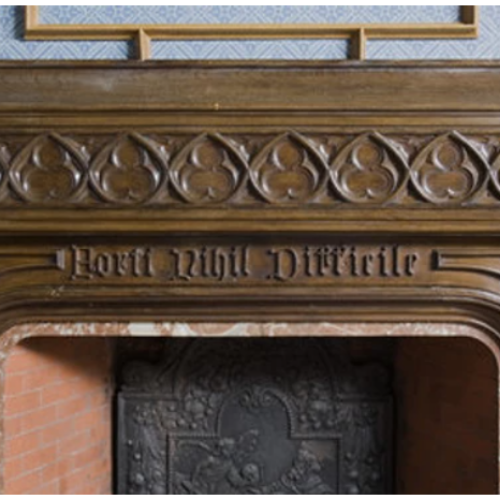
On a beautifully sunny Saturday a few weekends ago, I visited Hughenden Manor, the former home of Prime Minister Benjamin Disraeli and now a National Trust home. My eldest son is particularly interested in history and, when touring the house, asked the guide what the inscription above the fireplace in the dining room said. It read: ‘Forti Nihil Difficilius’ or ‘Nothing is too difficult for the brave.’ I was reminded of this when I attended the #WomenEd Unconference just a few days ago when I heard from and spoke to a host of exceptionally brave women leaders who embody the #WomenEd rallying cry to be #10%braver.
In my last blog, I explored the place of hope in schools. Do we, as educationalists and leaders, need to couple this hope with bravery? The wonderful Vivienne Porritt directed me to an article entitled ‘The Confidence Gap’ which explores how women are less-assured than men and how much confidence matters, a theme picked up in WomenEd’s book 10%Braver: Inspiring Women to Lead Education. There was so much within the article that I identified with. When discussing my career with others, how many times have I heard myself echoing the same mantra as one of the authors of the article: I am “just lucky”, I was “in the right place at the right time”? How many times have I suffered from the debilitating ‘imposter syndrome’? Even writing this blog, I am questioning why others would want to read what I write.
‘A growing body of evidence shows just how devastating this lack of confidence can be. Success, it turns out, correlates just as closely with confidence as it does with competence.’ (Kay, K. and Shipman, C. ‘The Confidence Gap’. The Atlantic. May 2014 issue.)
Taking on a new role takes bravery. In our schools, from trainees to support staff to pastoral leaders, a huge number of colleagues have taken on new roles this academic year … and that includes myself! Stepping into the very large shoes of the Trust’s former CEO has been, at times, very daunting. There have been numerous times when I have lacked confidence and doubted myself.
So, how do we all summon up the bravery to not only cope but thrive at these times?
1. Moral imperative
Michael Fullen, in Moral Purpose, explains that ‘Moral purpose is about both ends and means’. We make a difference to the lives of the pupils that we teach but the means to getting there must rely on all within the system – teachers, support staff, leaders – treating each other well, fairly and with integrity in order to achieve that ending. I completely agree with his sentiment. The life of a school (or for that matter, a Trust) is hectic, and the enormity of the task at hand can, at times, be overwhelming but I can say that the vast majority of professional, hardworking and dedicated colleagues that I have worked with over the years can still identify with the moral imperative of what we do. All children deserve to be taught well and receive the best possible education. This is particularly true for those for whom school is respite from chaotic (and sometimes dangerous) lives outside of school, those from economically or culturally disadvantaged backgrounds, those who do not have the advantages that others have. It is the moral imperative that for a huge number of educationalists drives us to be brave.
2. Family and friends
My family (on the whole) keep me on the straight and narrow. We all need social interactions, love and belonging to thrive. Which leads on to …
3. Connectedness and belonging at work – The Multiplier Effect, Leaders Eat Last, The Culture Code
I have recently been reading my latest Andy Cope ‘fix’ – Leadership: The Multiplier Effect. Chapter 4 explores motivation at work and how to move from job ‘satisfaction’ to ‘engagement’. Cope quotes Gallup’s Employee Engagement Survey which asks a series of questions to gauge connectedness and motivation at work. Of all of the questions, I think my favourite is ‘Do I have a best friend at work?’ An oxymoron, I know, but I could not count on two hands the number of ‘best’ friends that I have at work. I am incredibly privileged to work with some of the most empathetic, kind, generous-spirited, funny people I know!
4. Taking risks
In Leaders Eat Last and The Culture Code, the authors echo a similar message as Cope. Feelings of connectedness and safety are essential traits of a thriving culture. In order for us to feel brave, we need to feel safe in our environment.
5. Gratefulness
At the end of the day, it is so important to remember what we have and what we are grateful for. If my bravery wavers, I try to turn my attention to those I know, personally or not, who are fighting their own fight with courage, bravery and determination.
During meetings at Pioneer Educational Trust, we start meetings with a ‘check in’ which includes asking attendees what they are grateful for. I think this is so important as it refocuses our attention on all of the ‘haves’ not the ‘have nots’. It is easy to get sucked into a cycle of feeling as though the world is against us. What I know is that it is not.
It was a joy to meet with such inspiring women at the weekend’s #WomenEd Unconference and I have since been reading my book with enthusiasm. In the book, each chapter details a role model that each of the authors have been inspired by and, to end this blog, I wanted to share just one of my role models: Suzette Collard (nee Passy). Suzette was born and raised in Egypt before marrying an English man just after the Second World War and moving to England. Being a foreigner in these lands, she was met by immense xenophobia and had to show great bravery to adapt to her new life and thrive. When I was younger, she was just my grandma but now I fully recognise the power and strength to be gained from her example.
I pledge today and every day to be 10% braver and to encourage all women I know to take a risk, connect with one another and have the courage to break out of the mould and achieve.