

Written By: Oliver King – Deputy Headteacher, Upton Court Grammar School
Pioneer Educational Trust is committed to driving equality, championing and celebrating our diversity and promoting and embedding inclusion throughout our organisation. The Trust is committed to achieving this aim because we recognise that driving equality is the ‘right thing to do’ and that there is a clear legal, moral and strategic imperative that underpins this vital work. As an organisation we are legally bound to fulfil expectations with respect to the Equality Act 2010 and Public Sector Equality Duty; expectations which we aim to exceed. We have a clear moral imperative to use our individual and collective voices and actions to drive equality and equity, celebrate diversity and embed inclusion. There is also a strong strategic imperative to increase organisational performance through increased diversity; an area of work that I find particularly captivating and which forms the basis of this article.
Diversity matters
McKinsey and Company, a US-based management consulting firm founded in 1926, help organisations across the private, public and social sectors to create change that matters most to them. They have been developing research and initiatives on the topic of diversity in the workplace for many years and published Diversity Matters in 2015. This has since been followed by other publications, including Delivering through Diversity and Diversity Wins.
In Diversity Matters1, McKinsey and Company concluded that in a world that is both diverse and deeply interconnected, companies and institutions with greater levels of diversity are achieving better organisational performance. Their studies demonstrate that companies with a strong strategic imperative for diversity are better able to recruit top talent, and improve their customer orientation, employee satisfaction, and decision making, leading to a virtuous cycle of increasing performance (see figure 1). The report also suggests that diversity beyond gender and ethnicity/race (such as diversity in age and sexual orientation) as well as diversity of experience (such as a global mindset and cultural fluency) are also likely to bring some level of competitive advantage for organisations that are able to attract and retain such diverse talent.
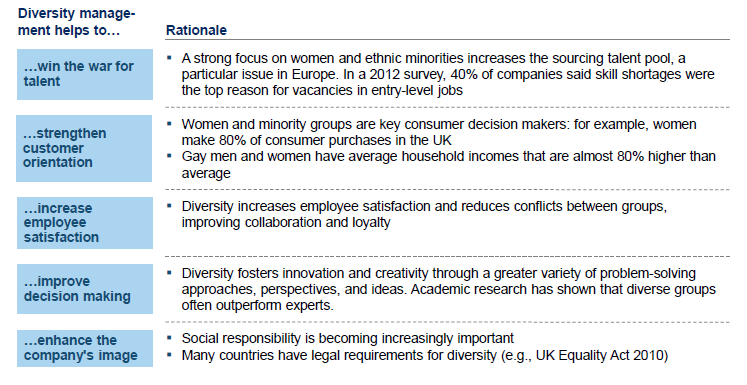
Figure 1 – A strong strategic imperative for diversity has a positive impact on many key aspects of organisational performance
McKinsey’s report highlights a clear trend that increasing the diversity of an organisation increases employee satisfaction and fosters positive attitudes and behaviours in the workplace. It also improves decision making and leaders working on challenging problems often assemble diverse teams of thinkers to challenge one another and improve the quality of their solutions. A diversity of informed views enables objections and alternatives to be explored more efficiently and solutions to emerge more readily and be adopted with greater confidence.
Cognitive diversity
In his book, Rebel Ideas: The Power of Diverse Thinking2, Matthew Syed is completely aligned with McKinsey’s Diversity Matters report and explains how diversity is the power of bringing people together who think differently from one another. He defines diversity as the critical ingredient to collective intelligence; an ingredient that supports wholes to become more than the sum of their parts. As with McKinsey’s report, he refers to the multitude of different types of diversity such as differences in gender, race, age and religion which are sometimes classified as demographic diversity or identity diversity. The specific focus of his book is how the differences in perspective, insights, experiences and thinking styles, known as cognitive diversity, are set to become a key source of competitive advantage, and the best route to the growth of an organisation. Syed highlights that there is often an overlap between the concepts of demographic and cognitive diversity; people from different backgrounds, with difference experiences, often think about problems in different ways and from a wider array of perspectives.
Syed meticulously explores the concept of homophily3 (meaning love of the same) which refers to the tendency for people to have ties with people who are similar to themselves in socially significant ways. He explains that homophily is pervasive and that our social networks are full of people with similar experiences, views and beliefs. The main disadvantage of homophily is that it is like a hidden gravitational force, forcing teams towards one corner of a problem space highlighting many blind spots in the process. Syed is clear in his assessment that cognitively diverse groups express a different dynamic. They are not clone-like and do not support the same views. Instead, Syed likens them to a group of rebels. They do not disagree for the sake of it, but bring insights from different areas of the problem space. These groups contain people with perspectives that challenge, augment and diverge generating creative ideas and solutions. He builds on this understanding with the knowledge that teams that are diverse in personal experiences tend to have a more nuanced understanding of their team members. A team with a wider array of perspectives and fewer blind spots builds intelligence not on the intellectual brilliance of individuals but upon their collective diversity and in doing so demonstrates the real power of cognitive diversity and diverse thinking.
Syed concludes that the very meaning of collaboration changes when diversity is thought of and spoken about in this new way. He explains that honest dissent is not disruptive, but imperative. Divergent opinions are not seen as a threat to social cohesion but as a contribution to social dynamism. Reaching out to outsiders for new ideas is not an act of disloyalty but the most enlightened form of solidarity.
Celebrating diversity at Pioneer Educational Trust
By committing to diversity as a strategic imperative, Pioneer Educational Trust aims to align our organisation more closely with an increasingly heterogeneous stakeholder base of students, members of staff, parents and governors. This alignment is forging stronger bonds with our key stakeholders and will yield highly effective decision that utilises key stakeholder perspective.
McKinsey’s report highlights that most organisations have work to do in taking full advantage of the opportunity of diversity, and, in particular, more work to do on the talent pipeline: attracting, developing, mentoring, sponsoring, and retaining the next generations of global leaders at all levels of the organisation. Given the increasing returns that diversity is expected to bring and linking this closely to collaboration, as Syed so eloquently does, our Trust is investing now. The organisation is utilising the power of cognitive diversity and investing in all of our members of staff through high quality, meaningful and collaborative Continual Professional Development & Learning (CPDL) as well as driving through a comprehensive three-year Equality, Diversity and Inclusion Strategy.
With regard to CPDL, each school in the Trust finishes the school day early for students every Wednesday. The additional hour gained each Wednesday is dedicated and protected time for CPDL and amounts to thirty seven additional hours of CPDL per academic year. This time is arranged in six week CPDL cycles and is allocated in the following ways throughout the year:
- Department (secondary)/Phase (primary)
- Pastoral (secondary)/Inclusion (primary) team
- Educational/Non-educational support staff/Cross-Trust programmes
- Pioneer collaboration networks/workload and wellbeing committee
- Safeguarding (all staff)
- Personal reflection time
The Pioneer collaboration networks delivered every week two of the six-week cycle are a prime example of how the Trust is embracing the concept of cognitive diversity, leading to enhanced learning for all. At the start of this academic year the menu of different CPDL opportunities below was offered to all members of staff within the Trust. The aims of the networks are to provide staff with autonomy enabling them to select the right programme for them, achieve mastery by deepening their knowledge and understanding in a topic of their choice and creating purpose in matching a programme to their individual needs.
- NQT and RQT programme (compulsory for all NQTs and RQTs)
- Aspiring middle leader programme
- Aspiring senior leader programme
- Coaching circles
- Curriculum diversity workforce
As all of the programmes delivered are cross-Trust the groups comprise of people from myriad of backgrounds; all with varying experience and perspectives that challenge, augment and diverge generating creative ideas and solutions to problems. These teams are so diverse in personal experiences that they encourage a more nuanced understanding of their team members with each group’s intelligence built upon the team’s collective diversity. In addition, the teams generate a sense of belonging and togetherness between colleagues in a safe space where all demonstrate unconditional positive regard for one another.
The coaching circles and curriculum diversity workforce have a particular focus on utilising the power of cognitive diversity. The coaching circles programme is a vertical development programme in which members of staff, all with diverse experiences, explore a topic of their choice deepening their understanding through journaling and peer support. The Trust fully believes in the power of coaching and the unique experience that provides both high support and high challenge. This programme provides group members themselves an opportunity to challenge and augment on the key aspects of this topic which aid their own professional development. The curriculum diversity workforce is a cross-Trust working party exploring diversity and intersectionality in our curriculum. Through engagement in research, this working party is exploring usualising diversity in the curriculum through the professional development strategy Spirals of Inquiry. As with the coaching circles this group comprises of members with different experiences and perspectives that all support the objective of enhancing our quality of provision.
As well as the Pioneer collaboration network a bespoke CPDL programme for non-educational support staff on the topic of equality, diversity and inclusion (EDI) is delivered on week two and week four of the CPDL cycle. The programme has supported non-educational support staff to explore the legal, moral and strategic imperative of EDI with new learning delivered cross-Trust in week 2 of the CPDL cycle. The new learning is consolidated by an application of learning to their individual roles using a coaching model in week 4.
To create such a cognitively diverse culture, ring-fenced, frequent, regular periods of time dedicated to improving practice are an essential ingredient of a self-improving Trust. Our greatest resource are our members of staff and their most precious resource is their time; it is common sense, therefore, that we must give our greatest resource the time to learn to be the best they can be. Our organisation’s investment in high-quality, meaningful and collaborative CPDL whilst celebrating diversity is a vital part of our overall recruitment and retention strategy.
The overall Trust three-year EDI strategy aims to drive equality, boost and amplify diversity and embed inclusion in line with the legal, strategic and moral imperative discussed. This academic year’s objective is to raise consciousness, educate ourselves and collaboratively and democratically develop a three-year strategy utilising the power of cognitive diversity. All members of our Pioneer community will be a part of our EDI volunteer army led by designated EDI champions who will work across the Trust and within their own schools. In doing so each team has a wider array of perspectives and fewer blind spots that build intelligence upon their collective diversity and harness the power of diverse thinking.
To lead this work, the Trust has established a diverse cross-Pioneer EDI Steering Party, as representative of the nine protected characteristics as possible and who will work alongside the team of EDI champions, whose role will be to:
- Develop and refine the EDI strategy including setting goals and in line with our vision, values and mission, and stakeholder engagement
- Track progress of work using agreed-upon indicators at steering party and EDI champion (working group) levels
- Make connections between EDI champions (working groups) to ensure co-ordination, efficiency and effectiveness
- Engage in stakeholder voice
- Serve as vocal champions of the collective impact effort
- Use influence and authority to assist the project in achieving its outcomes
- Act as inclusive allies
- Actively participate through both the meetings and active involvement
- Measure the impact of the strategy
This strategy is at the core of the Trust’s agenda of driving equality, championing and celebrating our diversity and promoting and embedding inclusion throughout our organisation. The work will maximise diverse thinking, be informed by the diverse ideas and perspectives of our stakeholders and will amplify the voices of our community in order to shape an increasingly diverse organisation. Syed believes that you can only build a culture of diversity when you have first grasped the concept of diversity; a vision Pioneer Educational Trust is wholeheartedly committed to achieving.
References
1 Vivian Hunt, Dennis Layton, Sara Prince, Diversity Matters (McKinsey & Company, 2015).
2 Matthew Syed, Rebel Ideas: The Power of Diverse Thinking (London: John Murray, 2019).
3 Definition of homophily. Available at: http://www.analytictech.com/mgt780/topics/homophily.htm#:~:text=Homophily%20refers%20to%20the%20tendency,refers%20to%20an%20internal%20preference